Wednesday, August 29, 2012

I'm Back!!!

I'm a married lady....finally.  The wedding was fantastic and the two week trip to Europe was amazing.  Couldn't ask for a better way to end my summer :)
I know I said I had left side activities to post about and I'm currently working on that post.  I also made it into school today (and will be there tomorrow) and I have pics to post.  Just wanted to say hello and don't worry - blog posts are coming!!!
I'll leave you with a lovely pics from Mt. Vesuvius and Pisa!
Ciao!


Friday, August 10, 2012

I'm sorry!

So I wanted to post left side stuff before I left.  It's not happening.  Planning a wedding is a lotttttt of work!  I can't believe it's here.  So I have a list of things to touch upon when I get back from this European Extravaganza:

- Left Side Actvies
- Grading the ISN
- Flip class and the ISN (anyone out there do this? Let's chat!)
- BYOD fun
- Of course, my classroom!!!!
Get excited about these posts...haha.

Those of you who are going back to school, good luck!!  Those of you who go back in September, ENJOY THE REST OF YOUR SUMMER!!!!  I know I will :-)

Friday, August 3, 2012

Supplies and "How-to" Organization Part 2 - Pictures!

I wanted to post some pictures that could help describe my last post.  With the wedding coming up and me living over an hour away from school, my visits to school have been minimal to say the least.  I'll get into school at the end of August and I'll post pictures of the classroom then.  I hope these help you out :)

Composition Notebooks

These are the BEST.  I love them.  When there is a sale - I buy them in bulk.  I find these to be the greatest because things don't fall out.  Just make sure you laminate them (packing tape and contact paper)  They are small, compact, and all around just easy to carry.  They are also fun to decorate <3

This is just some scrapbook paper that I found in Michael's that was on clearance AND another 15% off because I had my teacher ID.  I can't WAIT to decorate this :)


Can't Live Without Supplies - most of them :)


I've said it before, I'll say it again, I LOVE COLOR!  I just don't understand teachers that have rooms without color and student work NOT around the room.  It's boring.  I don't do boring if you haven't noticed :)  To make your ISN a success, it's always great to have color to help the kids ideas become a success on paper.


Glue sticks and tape (missing) are a must, must, must for this to be successful.  If you look at the glue that I like to get for class, it's the jumbo sticks.  Totally the best.  Lasts forever and takes a beating from my kiddies.  

We mostly use tape in my class.  I find the tape a little faster to use.  I have to model (no lie) how to use tape and glue over and over.  It takes awhile for them to get it, but eventually, they do.  If you do the ISN where need to attach lots of papers (like mine), you'll go through this stuff A LOT.  Make sure you have enough glue or tape to last you (I have tape suggestions in my last post) because if you don't, it makes it very difficult to make the book a success.


Let's start with the pencils.  I find that when students are working on the left hand side of the page, pencils are the best to work with.  They make mistakes and need to erase things as they work.  I can't say that pen won't work, but when they do make a mistake or they aren't happy with something, they tend to cross things out and it becomes messy.  If your using this book for the first time, pencils might be a must have, but again, totally up to you :)  One thing is I KEEP the pencil in the classroom in my closet.

Highlighters are fun and colorful and bright.  They make the ISN pop!  Just make sure you model what you want because if you don't It can bleed through.  I keep 2 in each bin and have a bucket for myself when we do whole group activities.


I love colored paper.  This is just a small sampling of what I have a home.  I could make foldable, after foldable, after foldabe with this stuff.  It makes the work pop and the kids love choosing which paper they want for their foldable. 

Just for Fun!


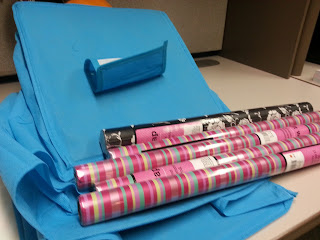
Pinterest (Follow Me!) has made me look at different ways to organize classrooms.  I found there was this obsession with gift wrap to make things look awesome in the classroom.  I'm going to give it a shot (found these in the dollar section in Target <3) and try to make the desk and filing cabinets looks amazing.  The blue clothing thing is something that I'm looking to put in the closet for more places to put supplies - this was only a dollar so we'll see how long it lasts.

ISN Bins

Ok, so before you take a look at the pictures below, I just want you to know this is the bin that I use in my class.  The one that I have at home is NOT as deep as the one that I have in school.  Surprisingly enough, this bin actually held the stuff that I has at home - so hopefully this will give you and idea of what to do until I can actually get in the classroom.

You should notice that this bin is a clear bin with a top.  I went with colorful ones and open top ones and there was always a mess.  I found clear plastic bins with tops on them so I could see when the mess started to form (papers in the bin, things that didn't belong) and the kids were more willing to clean up.  Don't ask my why this happens.  I really think it's because they know I won't dismiss them until that cover is on (and everything should be cleaned out of the bin before the top is on), but it works.  Why break something that isn't broken, right? :)


My bins I use at school are much deeper - they can hold a tape dispensers which is a MUST!  This one is nice though if you're not using the dispenser.
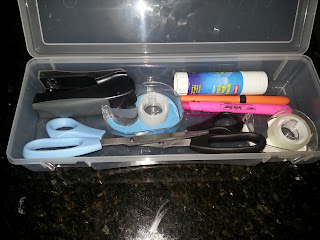

This is a picture of a bin that has everything inside of it.  My ones for school have more scissors, more glue, and tape dispensers in it, but for the most part contain everything that's here.  This is why the table issue is so important.  Having them in tables allows the ISN process to be much more seamless then if you have to keep going to get supplies and bring them back to your desk.  I know of teachers that are out there that are resistant to putting kids in groups.  I really just shake my head at this because my own personal beliefs is that they are doing a disservice to the kids.  We function as a society as a group....not one individual.  Don't use the excuse they are "just easier to handle this way" as your reason because it's not a reason.  If you try and it doesn't work, that's fine, but if you put them in rows just because it's easier for you, then that's just a sad reason in my eyes.  I'm really think about....really, really think about it.  A "trouble maker" is surrounded by 8 kids (the ones next to them and at the corners of them) in rows.  When they are at a table, they are with 3 or 4 other kids at most.  Wouldn't you think that to handle those behaviors a little more you'd like to give tables a try?  Use this ISN bin to your advantage.  Use it as an organizer but also use it as a classroom management tool as well. Kinda cool huh?

Next post:  There have been lots of people on here and my new friends on twitter (follow me @valdescience) who have inquired about left hand side activities.  Give me a until next week and I'll come up with some things that you can use to start to generate your own ideas for you classes.  I'm getting married next Saturday and off to Europe for two weeks, so I'll make it a good one for ya! :D

Tuesday, July 31, 2012

Supplies and "How-to" on Organization - Part One

Sorry - wedding things have sort of taken over my life.  It's taken me a little over 3 days to write this...sigh.  The response however from some of you out there really makes me smile and thanks so much for reading :)  It's pretty cool!


It's that time where we see all the lovely ads for back to school supplies.  We're just getting into August and things have been on sale pretty much for the past month.  Most schools in my area get out in mid June, so it's a little much to see this in my face at the stores.  I find this to be one of the reasons why I can't shut off  what I call "teacher brain".  The supplies constantly make me think of what I can do to make my classroom better.  Yesterday, I went shopping for the wedding - I spent most of it on school supplies (my usual MO).  Target and Staples are the worst because the sales are sooooo good.  Michael's, the craft store, might become my newest obsession as they give teachers 15% off with proof that you are a teacher - just a little fyi there.  Anyway, over the years I've found that a few items here and there that have made my experience in the classroom a lot easier when implementing the use of the ISN.  I'll start off with the supplies you might like and then how my class is organized so you'll see how easy it is to make the most of your supplies.  I wish I had pictures of my classroom to show you, but at least for now, you'll have a nice idea of what I do :)

Supplies

1)  I love composition notebooks.  I HATE binders because I find them big and bulky and a pain in the neck for the kids to keep.  Honestly, they will tell you that they aren't a fan of carrying them or having them in their locker.  I find it paper of other classes everywhere in my room.  When the kids come into my room, their binders are alllll over the place - it's annoying to the kids and it's annoying to me.


I'm going on year 5 with the composition notebooks.  They are small, easy to carry, and once you get the hang of it, it becomes so easy to put your worksheets in.  When I let the kids decorate their books, I ALWAYS laminate their books with packing tape as it helps make the book stronger.  I've also seen contact paper used which is just as good.  It makes them more durable to last throughout the year.


Now I may love the composition notebook it doesn't mean that a binder or a spiral won't work for you.  They can work if you feel more comfortable, but I've just seen more success from the other notebooks because it's a lot harder for things to fall out.


2)  TAPE, TAPE, TAPE!  You will need tape during this endeavor of using the ISN.  Obviously, the best kind of tape out there that I've found is Scotch but Staples is just as good.  Having tape dispensers is always a plus as well.

Some schools might provide this to you.  Jump on top of it they do!  If not, I've been looking to try a Donors Choose project.  You might be able to get it funded for you! If that still doesn't work, I did a tape drive with my kids.  Every little bit helped, and the kids won little prizes as well.  I did ask for some on their school supply list.  Some kids brought it in and some didn't - I was ok with that and very much appreciated what my kids could bring in.

Sales wise - right now staples has that 15% off card where you can get 15% off your order once a day until some point in September.  It's $10, but I overheard the cashier say that if you spend $67 dollars, it pays itself off.  I did that in one stop yesterday, and if you have the rewards card, you can get them back at a later date.  There is also my favorite sale of half off Sctoch tape during December/January.  It's online and worth it.  I stock up each year!

3)  Glue Sticks - every once in while you get that kid that just can't use tape because of one reason or another.  Yes, I teach my kids how to use tape because they just feel like they can use as much as possible.  Yet, there are some that just can't do it.  Glue sticks become another option.  I like the really big Staples ones just because they last longer.  Right now, they are 2 for $3 until September - remember you can get that 15% off too :)

4)  The ISN deals with how the brain works.  Color definitely has to deal with how the brain works.  I made a map below of my classroom and it's all in color and everything had to be different colors if they were not the same as another item.  It's just the way my brain works!  Crayons, Colored Pencils and even Markers are key into having successful books.  Students need to express themselves and color allows this to happen.  We are looking for our students to "create", the color is a critical tool in allowing for this to take place.  Another way is to help the kids organize their thoughts if they are making something like a mind map.  The uses for colors are endless :)

4b)  I'm calling this 4b because it's NOT something that I find is needed, but I find just nice to have.  Colored computer paper - I love to make foldables out of this.  Again, it's a way for the kids to organize their thoughts, and I swear, they remember what pages things are on because of the color.  If you can get some from your school or again maybe a donors choose project, do it!  The kids will love it.

5) Scissors - This may seem silly to put here, but it was really important have these available to the kids.  IF you look to go the composition route, the paper obviously needs to be smaller or the kids may need to cut them out.  It just make it easier if you have enough for most the kids in the class/tables (more on that in a second).

**PS - papers you put in your ISN - it's a post to come, but to save time, shrink when you copy - saves so much time**

6)  HIGHLIGHERS - Love, love, loveeee highlighters!  It's great to have several colors available to the kids.  They are more willing to again organize via the color - such as mind mapping.  Also, if you require the kids to underline something, those kids who love color (many do) will probably want something different.  The highlighter does that for you.  It's a great little tool that helps the ISN just become a tad bit stronger and give that thing called purpose a little bit stronger.

Extra - I have little staplers around the class for the kids.  Sometimes, depending on what we do, the kids preferred the staplers.  The small ones worked out well this year.


Organization

So all that stuff above is really nice and cool to have, but I don't have these things all over the place (although, there are times where I feel like everything is everywhere!).  I have places for everything.  Below is a map of my class:


Map of my classroom - organization is the key :)
I don't have the biggest of classrooms.  I would nicely call it cozy for 24 kids, but for now, it works.  I have to make it work because I really don't have a choice :)  Having a place for EVERYTHING makes this small space work.  


1)  I find, in order to make this work, tables are the way to go.  I find that that if I create a bin for each table with the following items:
  • Tape Dispensers
  • Scissors
  • Glue Sticks
  • Highlighters
  • Little Staplers (in my class at least)
These are what I call my ISN bins and it is shared with 4-5 kids.  I don't have to worry about passing out materials, passing back materials, or individuals going around the classroom to grab materials around the room.  The bin is right there and the kids learn how to work together as a group.  I love groups, and I and really NOT a fan of rows.  From my perspective, where is the learning taking place in rows?  Who knew having a little bin could led to lots of learning :)

Now, I saw this idea on Pinterest a few weeks ago (if you're not on Pinterest, get on there, explore there, LOVE it there - great site for teachers).  It keeps a photo of what should go in your bins.  I think that this might work more for my kids rather than have it actually written on the bins.  I feel like kids are more likely to look at the picture rather than read what I may have written on top.  My bins are clear bins with a top on them.  They seem to bee a little be more durable, but the picture below (website is listed in the caption) will allow you to have an idea on how the bins work.
http://www.theartofed.com/2011/08/17/picture-this-labeling-supplies/
2) Keep the crayons, markers, and colored pencils separate!  As much as I love them, they can be a real pain in the butt when it comes to clean up.  I keep them in separate containers by my desk.  On top of each of the containers, I have separate bins so the kids can come up and put whatever they need in them and take the bin back to the table.  The kids use the materials and with a few minutes left in the class period, they go back to the main bins and put their things away.  It helps keep the tables clean and the ISN bins clean as well.

3)  Paper Bins - I haven't really talked about the papers that can be put in your notebooks.  It's totally up to you, but when you create papers for your ISN, you need a place to put them.  Bins are the best for that.  It's great because the kids know where to go to get them and it's less likely they will be all over the place.  As you use the ISN each day, it become routine for the kids to go up to get the papers and then go back and sit down and take them to their notebooks.  At the end of the day, you can take those papers and file them away - don't forget what about Big Thing Number Two - this is where that comes into play.  Here's a picture of an idea of what the bins would be like:

This is just a graphic, but my bins are two different colors as well.
The supplies and organization of the classroom really helps the flow of the classroom and classroom management.  I know I sound like a broken record, but it's really up to you on how you want to set up your class, but some of these little tips and tricks have helped me out over time.  Part 2 of this blog - some pictures about what I described in some of items above.  I don't have pictures of my actual classroom yet, but I have enough supplies at home to give you an idea. So...so...so sad.   I'm a beat and it's another early day tomorrow :)

Thursday, July 26, 2012

3 Big Things for Teachers to Know About the ISN

It is no secret that I love the Interactive Student Notebook.  The way you can use your ISN is endless.  I wanted to go through some ideas and strategies that you can use in class to help you become more successful.  Two of the items, I want you to really start to think about the process behind creating your own assignments.  The other is just a little organizational tidbit that any teacher using the ISN should do.  They are ideas that I came up with from my experiences and hopefully it can give you some ideas.

TEACHERS:

1)  Make your own ISN.  You will use this ISN more than you think.  It's a place where you can sketch out your thoughts and ideas.  Having your own is a great help as you learn how to change from using the typical notebook to the ISN.  As you become more comfortable with the book, you'll begin to see the activities you plan become more elaborate and allow for more higher order thinking activities.  For some reason, I find that helps to have the book in front of you in order to create the entries. 
    Tide Notes: I was able to place the notes underneath to make it fit.
    Tide Notes:  I sketched it out to make it all fit.  Took at little time, but it turned out great.  If I didn't have the book in front of me, I probably would not have come up with this idea.
2)  Your copy = a savior for when kids are absent.  This has been amazing!  I can hand over my book and they fill out the information they missed. 

I haven't really talked about the papers and how things are placed in the book as of yet, but in my pictures you can tell there is a lot of taping/gluing which means there are lots of papers.  When the kids are absent, it's so difficult to keep these papers in order unless you have a system. My co-teacher introduced me to this idea of having a file folder container.  I have a container that has 31 file folders in it, and the folders are labeled 1-31 to represent each day.  The kids can go over to the container, pick out the papers they need, and set up their book on their own.  I can continue on with my lesson without being asked a million and one questions.  It helps the kids and myself stay organized.  I got mine from Staples (I may have to shop somewhere else now because of the lack of love for the teachers...sigh), but I'm sure you can find them in any office supply store.  Totally worth it.
Something like this would work for keeping the papers organized


2a) I tried to come up with a class ISN that someone would fill out for me everyday, but it didn't pan out the way I wanted.  My co-teacher and I are working on ways to improve that.  It will be nice to have another book in the class as a reference or when more than one child is out at a time.  When I come up with a system, I'll let you know :)

3)  This is somewhat tied with number.  It's like the outcome of the planning!  This ISN becomes your textbook.  I don't have textbooks that can go home with my kids.  We're lucky enough to have about 15 textbooks per teacher and books online that all kids can access (if they have the internet at home).  We also have lab manuals which I absolutely despise and are nicely packet away in the back of my classroom ;)  You control the content that goes into your book, and not the textbook company.  Remember that purpose thing?  It comes into play here!  I may use some of the information from the textbooks, online, and other sources to create my book that meets my states standards.   It's fun!

This is a picture from a student's notebook.  The right is my side (parts of an atom notes) and the left is there side (the student's created a cartoon about the notes)

The kids love the idea about creating their own textbook.  It's nice because the ISN is really all they should need when it comes to any kind of assessment.  You have your important information you want to kids to know right inside your ISN.

These are just three simple and easy ideas for the teacher.  If there is one thing that you've noticed throughout is the idea of creating your own materials.  It's up to you and that might be a very daunting task for some.  Don't worry, I'll have some ideas in the future for you :)  Hopefully you're starting to see the benefits of using this book.  I mean we've all said it before, "If I created this textbook....".  Well, now here's your chance!

Wednesday, July 25, 2012

ISN Part 2 - The Pages and Purpose


The pages after the beginning setup is where the real magic happens.  Each side of the notebook serves a purpose.  The ISN has to have a purpose otherwise the book becomes meaningless to your students.  I've seen this too many times where cutting and pasting is done to waste time or done because 'it's what you're supposed to do'.  It's not.  What you're supposed to do is have a meaningful book that will allow for students to explore learning on their means.  Just putting lots of things on one page does not make it interactive - it makes it a disaster.  The kids get frustrated and your purpose of using the book is lost.  

The teachers that just do the ISN to waste time and look 'good' makes me beyond angry.  I'm rather passionate about this tool.  It really just makes my blood boil when people think they are 'doing the right thing' in their minds and just use it as a way not to teach.  It happens more often than you think.  You are the ones in the classroom that make the ISN meaningful to your students.  Your students will pick up on the fact that your book has no true purpose if you don't use it in the right matter.  That's where this whole perception of this 'baby work' comes into play.  Of course it's baby work if that cutting and pasting and the use of a crayon here or there is done without a purpose.  It's not baby work when the kids can turn to a perfect stranger to the classroom (such as observations) and explain the meaning and purpose behind an activity that they are doing.  It's a disservice to the child if one's goal is to just waste time and just do something because 'everyone is doing it'.


The word purpose stands out because you want to make sure your book has a purpose to your students.  Look at it as if it's a textbook.  Textbooks should have meaning (I know, that's not the case all the time)  What's nice about this book is that you get a side and the kids get a side.  In my book, my side is the right side and the kids side is the left side.  It's a little hard to get used to at first, but it's set up that way because of how the brain works.  You can make yours and go with the opposite way if you're more comfortable, but just make sure you have a side and so to the kids.   

Here's how it works:


On the left, you really want to see if the kids understand what you taught on the right.  Some kids might have a difficult time with a topic and the completed activity might be very limited.  That's ok - you as the teacher can go back and look and see what they might be missing or help scaffold the notes even more so to help them understand the topic or complete and activity.  You can also use the left side as a place where kids can as questions about the topic.  I do a fishbowl activity during the year with the kids and use a "KIQ" Chart - What I know, What I find Interesting, What Questions I may have about the topic.  It's a great way to see what they are missing from the lesson.  The options in this notebook ARE ENDLESS, but just remember, those options need to have a purpose. 

I found the hardest thing to do for the the ISN is coming up with activities.  The following website has been my bbf since the good old days of 2008.  There are lots of links (in all content areas) and lots of ideas to start to think about how to use the ISN.  I have a list of activities that I use and some that I've made up over time.  I'll post those for you one day, but with my wedding coming up in 2.5 weeks (gulp!), time isn't on my side....buttt I don't want to leave any of you hanging so check out the website!


ISN Wikispace - go here, bookmark this, whatever!  Take a look, it's helpful :)


Below are some examples from my students - again, I'm going to do my best the next few weeks to go through the step-by-step process of this, but seeing this for now gives you a bit of an idea what the ISN can look like.
Left Side:  Moon Phase homework - describing the positions of the Earth, Sun and Moon during Full and New Moons
Right Side: Moon Phase foldable that describe each phase of the moon


Now the above is just a format that you should try to follow, but there are times where you may need both sides of the book for your information - that's ok.  It happens from time to time.  You do what you need to do and then just go back to the format.  Remember, you want to keep the kids organized so if you need more space, it's fine.  

I know I've just hit the tip of the iceberg with this post, but it's important that you know that you have so many options with this notebook.  I want to describe I how use the ISN to you next and it's function it serves in my classroom.  Hopefully after you read that, you will soon find the way the ISN will fit your purpose in your classroom.

Tuesday, July 24, 2012

ISN Part 1 - The Beginning and Organization

In my last post I said the ISN changed my life.  It can change yours too.  Don't be fooled that this is something that you can ONLY do in science.  It's something that works across the board and I have seen successful notebooks in all content areas.  

As the teacher, you can't control the content you teach, but you can control how you teach the content.  

I feel like the second part gets lost with many people.  The ISN allows for the teacher to 'control the way you teach' in ways that can be considered beneficial to your students.

So, how does this little thing work?  It's up to you on how you make it work, but the idea behind is it that the students get a place in their books to explore the content.  It's also VERY, VERY, VERY organized.   I am not the most organized person, but when I learned about this, it was like the clouds parted in the sky and that bright light came through.  I seriously thought, "Krystina, this is what you need."  It totally was and still is. 

The kids, you know the ones that are like, "Oh, that paper, yeah, I don't where it is. Do you have another one?" or the ever popular, "It's in my locker, I think," won't misplace their work.  That right there should get ANY teacher giddy with excitement!  If you really think about it, sometimes as teachers (and let me state not all teachers) write kids off as not being able to pass because they are lazy or they just aren't trying enough.  Anyone ever take into consideration they just might be a kids and some can be more disorganized compared to others.  I see it too often and it bothers me because maybe it's not that they aren't trying, but even in 8th grade, they haven't mastered the organization yet.  It happens - especially when no one teaches them how to organize.  We should NOT assume they know how.  We can't write them off and tell them that 'they'll have to do this next year in high school' (I HATE IT WHEN I HEAR THAT FROM TEACHERS).  The ISN helps tremendously content wise but more important with their organization.


I'm going to go through and show you my set up for the first part of the ISN.  You can change things  according to what will work for your class :)


1)  Yesterday I showed you an author's page.  That's just one way you can learn about the author of that particular ISN.  I love to see what the kids bring in because there are times where they draw, write, or even bring in pictures of themselves and their families.  It's fun to learn a little bit about themselves.

Here's just an example of one:


She wrote poems and words to describe herself

2)  Title page for the unit.  Some teachers out there may want to have sections in their books that pertain to the unit of study.  The title page is a great way to section this off within the book.  I use this page to see what the kids know about a particular topic that we are going to be studying.  Here are two examples of Astronomy title pages.


3) The Table of Contents or the TOC.  When you're a kid (or at least when I was), you're taught what the purpose of the TOC is and it's location.  I have it located right after the title page of each unit.  The kids fight me on it at first saying they'll never use it, but when we start playing games (like a scavenger hunt) or reviewing they begin to use it and realize it's purpose.  Even in the 8th grade, I have to teach my students different ways in how to study and the ISN provides me with many ways to do this.  

Each day the kids look at the Do Now and for the most part, it's to set up their ISN or do something within the ISN.  I'll post what the Do Now looks like in my classroom at a later date.

How does the TOC look?
  • Title - The exact title of the specific page
  • Page # - Important that the kids put it there this way they know where to look
  • Optional - Date - some kids like to put the date in the margin this way they know when they put that page in their ISN
Below you'll find an example of a TOC from a student's ISN from this past year:

These are two pages of the TOC for the Astronomy Unit
 As for the amount of pages, again, this is up to you.  I have used books where I only had two pages of TOC and books that I decided to have 4-6 pages.  If you run out of space, it's very easy to attach a piece of notebook paper in to the notebook so the students can continue with their TOC.  It's not a bad idea to actually have paper cut down to size (especially if your using a composition book) for the kids when this happens.  They love details and NEED their books to be perfect - they'll spend time cutting the paper down and forgetting about the actual TOC to copy in if there isn't paper ready.


4) Words Worth Knowing or the WWK - This might be one of my favorite part of the ISN.  You don't think about it, but science (as well as ALL other subjects) is filled with vocabulary that the students may or may not know.  From my experience, science has some pretty nasty words that are super difficult to say and have super long definitions.  They need a place to write this down.  Seriously, however many times you may say the definition in class, there are going to be kids that still won't get it.  The WWK gives them the opportunity to look up the words when asked.  This little reference area is critical.  Also does wonders for ELL students as well (more on that another time).


Over the years, I have changed the amount of pages that I've set aside for the WWK.  For me, I've begun to set aside about 6 pages for most units.  This allows all students with small print and large print to have enough space.  Again, having paper ready to be attached when they do run out of space is always a good thing - saves you both time.  Below is an example:

First page of the student's WWK for the Astronomy Unit
Just as a strategy, I highlight my words and number them in my own personal book.  I do this so the kids know how many words we have covered and how many words I'll be looking for when I check the notebooks.  It's more or less your own preference and you doing what you're most comfortable with the WWK.  I'm thinking this year that I may add the numbers on the board this way there is no confusion at the end.

This is only the beginning.  Yes, it's a lot to take in, and a lot of class time at FIRST, but if you are doing this for the very first time, over time it will become second nature for everyone in class.